

Virtualizor 3.2.9 — What's New
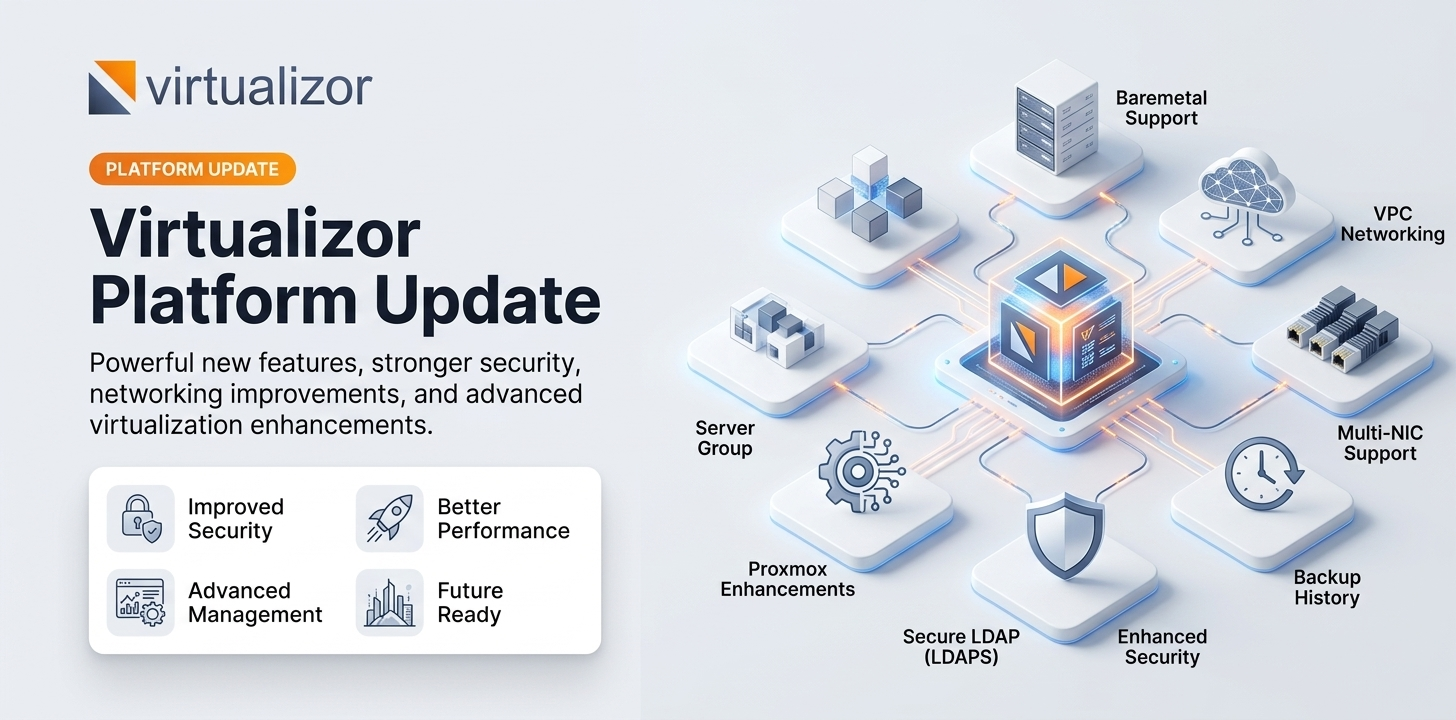
Virtualizor 3.2.9 is a significant release introducing full VPC networking, baremetal server management, and a range of improvements to security, API coverage, and platform stability.
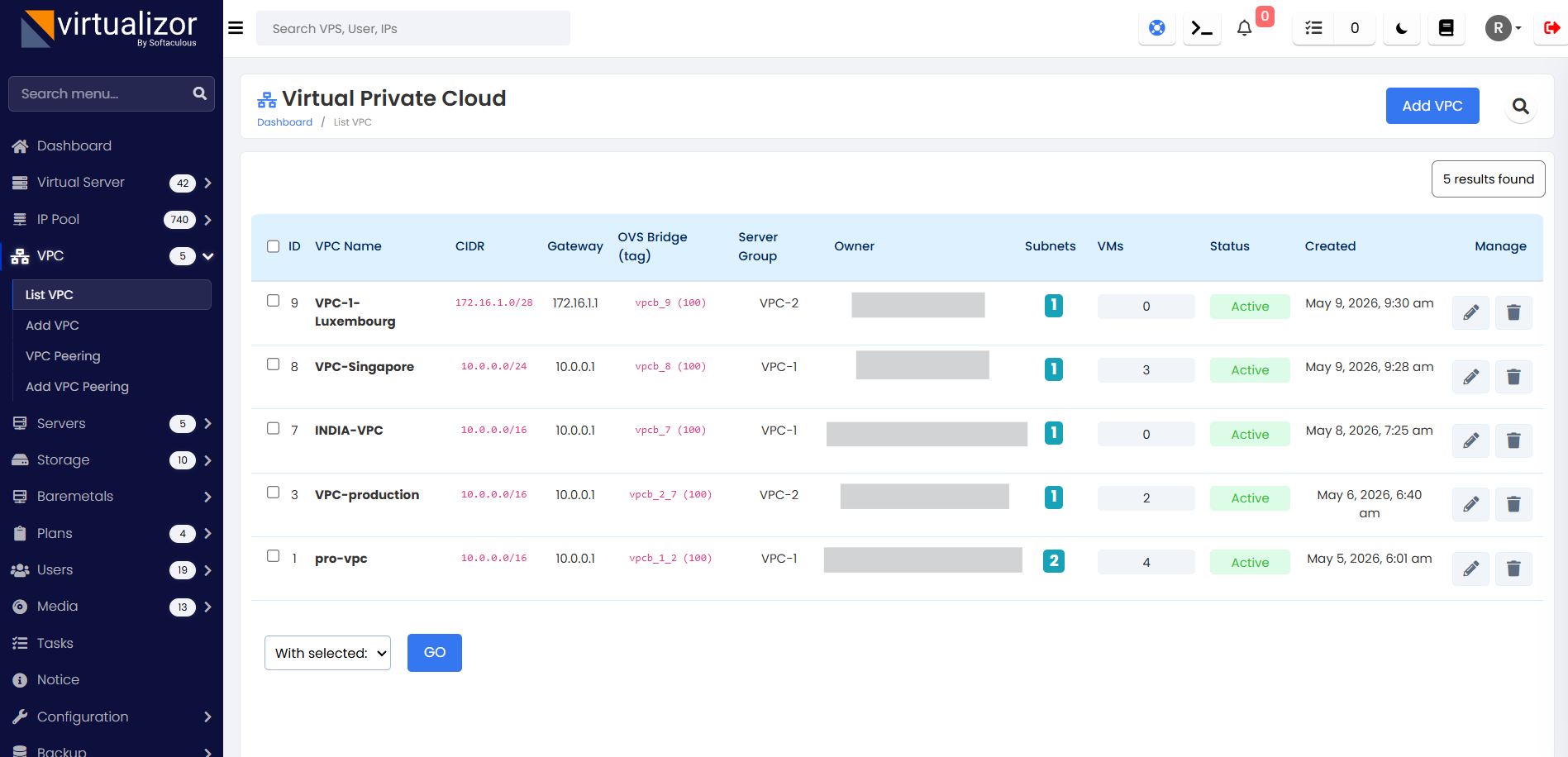
Full Virtual Private Cloud (VPC) networking support has been added. Administrators can now create isolated virtual networks and assign VPS instances to specific subnets for enhanced network isolation.
Physical baremetal server management has been introduced. This allows administrators to manage physical hardware alongside their virtual inventory within the same panel.
A hide_virtualization flag has been added to plans and individual VMs. When enabled, Windows-based virtual machines will not display "Virtualization: Enabled" within the Guest OS Task Manager.
A Secure LDAP option (ldaps) has been introduced for LDAP authentication settings. This enables encrypted communication between Virtualizor and your directory service for improved security.
Administrators can now terminate running backup tasks directly. Additionally, a dedicated backup history page has been added to track and review all previous backup operations.
The API response for creating a firewall plan has been improved to return the new firewall plan ID (fwpid) upon success. This simplifies automation workflows that require immediate reference to the new plan.
A new consolidated resource view has been added to the server group page. Administrators can now see the total RAM, CPU, and Disk usage across all nodes in a selected group at a glance.
Advanced CPU topology configuration is now supported for Proxmox KVM virtual machines. A thread count option has been added to allow fine-grained control over virtual core presentation.
Support for multiple network interface cards (Multi-NIC) has been implemented. Virtual machines can now be configured with several independent network interfaces for complex routing requirements.
Internal IP assignment is now supported for virtual machines using DHCP-based network configurations. This allows internal networking to be provisioned automatically via DHCP.
The following event hooks have been integrated for developer use:
suspendvps— Fired when a VPS is suspendedunsuspendvps— Fired when a VPS is unsuspendedbefore_upgrade_virtualizor— Fired before system binary upgradebefore_upgrade_virtualizor_db— Fired before database migrationsafter_upgrade_virtualizor— Fired after system binary upgradeafter_upgrade_virtualizor_db— Fired after database migrations
Several capability flags have been added for Proxmox LXC containers to enable advanced kernel features:
keyctl— Enable key management systemlxc_nfs— Enable NFS mount supportsmb_cifs— Enable Samba/CIFS supportlxc_fuse— Enable FUSE filesystem supportmknod_devices— Enable device node creation
The networking stack is transitioning from ebtables to nftables for network filtering. This modernises the firewall infrastructure and ensures compatibility with current Linux distributions.
The setting previously known as "Disable ebtables" has been renamed to Disable Anti-Spoofing Config. This change clarifies the impact of the setting on network security.
The editippool API call has been corrected to properly accept sgid (Server Group ID) as an input parameter. Previously, this parameter was being ignored during API requests.
Resolved an issue where the KYC verification page was failing to display identity documents uploaded by users. Administrators can now view submitted IDs as expected.
Fixed an issue where attaching a second disk to a VM with an existing backup plan would trigger a full backup for every subsequent run. The system now correctly handles incremental backups for multi-disk configurations.
The disk detection logic has been fixed to correctly identify primary disks for VMs with hostnames containing numeric characters. Previously, these were sometimes misidentified as secondary disks.
Network configuration for internal IP addresses has been corrected for Windows-based virtual machines. Internal IPs will now function correctly within the guest operating system.
The end-user panel now correctly distinguishes between locked and suspended states. Locked VPS instances will no longer be incorrectly labelled as "Suspended".
Security has been improved by ensuring both Admin and End-user panels correctly prompt for the current password before allowing a password change. This prevents unauthorised changes if a session is left active.
Email verification links sent during user registration are now set to expire after 24 hours. This reduces the security risk associated with long-lived unverified account links.
Resolved networking issues related to DHCP assignment on hypervisor nodes running AlmaLinux 10 or newer. VMs will now obtain DHCP leases correctly on these platforms.
A hypothetical SQL injection vulnerability in the authentication callback handler has been patched. User input is now properly sanitised to prevent malicious database queries. NOTE : This could not be re-produced and hence we are giving it a very low score on security
---------------- Patch 1 ----------------
1. [Feature] Added a real-time server load average display to the top bar of the panel.
2. [Feature] Added the VPC peering option directly to the end-user panel.
3. [BugFix] Fixed an issue where the email backup report displayed an incorrect count if a VM backup from the server failed.
4. [BugFix] Resolved an issue introduced in v3.2.9.0 that prevented Backuply from uploading backups.
5. [BugFix] Fixed a broken VPS domain forwarding wizard on the Manage VPS page.
6. [BugFix] Resolved DHCP IP assignment issues for Multi-NIC configurations.
7. [BugFix] Fixed an admin-side issue where re-adding VPC peering rules would fail.
8. [Task] Updated the VPS stats page to support live plotting for resource graphs.
9. [BugFix] Fixed a critical issue where Ubuntu networking was not functioning properly.
10. [BugFix] Resolved a "Primary IP not found" error during VM rebuilds when the IP pool, server, or server group was changed. This now displays a proper, descriptive error message.
---------------- Patch 2 ----------------
11. [Feature] Docker Manager has been added to the end-user panel, enabling seamless container management.
12. [Task] End users will now receive a suspension warning email when their VM exceeds the configured CPU usage threshold.
13. [BugFix] Slave actions were incorrectly accessible on certain pages. This has now been restricted.
14. [BugFix] Admin can now lock free IP addresses directly from the IP Pool list page within that ippool.
15. [BugFix] IPv6 pools can now be searched from the IP Pool page.
16. [BugFix] Users were still being prompted for 2FA even after it was disabled by the admin. This issue has been fixed.
17. [BugFix] Added search functionality based on Storage ID on the Storage List page.
18. [BugFix] Migration tabs were disappearing after migration completion. This issue has now been fixed.
---------------- Patch 3 ----------------
18. [Feature] Added Docker Manager for end-user VMs (Added support for Docker Compose YAML files).
19. [Task] Added gateway_out_of_range detection for the Virtual Network service to identify gateways that are outside the configured network range.
20. [Task] Added subnet support for API key IP restrictions and panel access restrictions.
21. [Task] Terminal connections now support hostnames and will open successfully
when a valid hostname is provided instead of only IP addresses.
22. [Task] Added
show_unavailable_plans setting under Billing → Cloud Setup. When
enabled, cloud plans that cannot be provisioned are displayed as
disabled, along with the reason they are unavailable.
23. [Task] Added Shift + Click multi-selection for checkboxes across all Admin
Panel and Enduser Panel pages, allowing users to select ranges of items
more efficiently.
24. [BugFix] Improved VM migration. During migration, firewall rules from the source node are now automatically copied to the destination node to prevent connection issues during transfer.
25. [BugFix] Made backup_rotation_count configurable. Previously hardcoded to 10, it can now be modified by administrators through universal.php.
26. [BugFix] Fixed a Proxmox issue where selecting Disk Driver: 0 with UEFI BIOS caused VM creation to fail.
27. [BugFix] Fixed an issue where rebuilding a VM using a Webuzo template with applications created an incorrect task.
28. [BugFix]
Fixed an email notification issue where users without any VMs received
emails when administrators selected specific nodes for email
notifications.
---------------- Patch 4 ----------------
29. [Feature] Added CVE notice with action to take option.
30. [Task] SSO link will be opened on domain name if valid domain name is saved for slave server.
31. [Bugfix] While migrating the VMs, docker information was not moved to new VM. This is fixed.
32. [Bugfix] While restoring the VM backup if the Slave node where VM is present was offline, at that time restore was failing. This is fixed.
33. [Bugfix] If docker enabled VM was reinstalled, docker containers were listed even after reinstalled. This is fixed. Now VM will be clean reinstalled.
---------------- Patch 5 ----------------
34. [Bugfix] Fixed an issue where the Docker link for the application was not created correctly on VMs with multiple IP addresses.
35. [Bugfix] Fixed an issue where network suspension did not work for secondary IP addresses.
36. [Bugfix] Fixed an issue where speed limits were not applied to secondary IP addresses when a VM had multiple IPs from different IP ranges.
37. [Bugfix] Fixed an issue where a newly created VM was incorrectly displayed with a Suspended status during creation.
38. [Bugfix] Fixed an issue introduced in v3.2.9.2 where disable_anti_spoofing_rules was reset when editing a VM, even if no changes were made.
---------------- Patch 6 ----------------
39. [Task] Added a "Use Server Hostname" setting in the Master Configuration, enabling the use of the server's domain name for Terminal access and SSO login.
40. [Bugfix] Fixed an issue where QCOW2 backup jobs could fail on servers where backups completed very quickly. The event listener was initialized after the backup had already finished, preventing proper event handling. The backup workflow has been updated to eliminate this timing issue.
41. [Bugfix] Fixed an issue where the ISO image list was not displayed on the VPS Manage page in the End User Panel.
42. [Bugfix] Added support for the SATA disk driver option in the Add/Edit Plan configuration.
43. [Bugfix] Fixed an issue where regions were not listed while adding a new datacenter.
44. [Bugfix] Fixed an issue where orphaned IP Pools (created when the associated server entry was removed from the database) were not displayed because no servers were assigned to them.
45. [Bugfix] Fixed an issue where CPU cores were incorrectly displayed as 0 on the Server List page.
46. [Bugfix] Fixed an issue with VPC networking provisioning, ensuring VPC networks are now created correctly.
---------------- Patch 7 ----------------
47. [Bugfix] Fixed an issue where Windows passwords set using the Guest Agent reverted to the previous password.
48. [Bugfix] Fixed the VirtNetwork service failing to start when a gateway could not be detected. The default route gateway is now used automatically.
49. [Bugfix] Fixed an issue where legacy file - based KVM VM backups could get stuck during the qemu-monitor-event operation because the BLOCK_JOB_COMPLETED or BLOCK_JOB_ERROR event was triggered before the QEMU event listener started.
50. [Bugfix] Fixed an issue where the SCSI bus driver was used even when IDE was selected during Windows VPS creation. The selected IDE driver is now used.
51. [Bugfix] Fixed an issue where the Delete VPS option was visible to normal users.
52. [Bugfix] Fixed gateway entries for internal IPs being incorrectly written to the VM network configuration and dhcpd.conf. A gateway for internal IPs is now added only when the VM has only internal IPs, and only on the primary network interface.
53. [Bugfix] Fixed IPv6 nameserver entries being incorrectly written to the IPv4 dhcpd.conf file when IPv6 nameservers were assigned to a VM.
54. [Bugfix] Fixed the default CPU threshold behavior. If no action is specified, the Suspend action is now used by default.
55. [Bugfix] Fixed an issue where Docker containers were deleted after a container update operation.
56. [Bugfix] Added an option to enable or disable SSL for S3-compatible endpoints, allowing connections to non-SSL S3 endpoints.
---------------- Patch 8 ----------------
57. [Feature] Virtualizor as a MCP server can be used.
58. [Feature] Added audit logs for Add/Edit Server actions and Master/Slave configuration changes.
59. [Feature] Added a new dashboard & new UI to the Enduser Panel.
60. [Feature] Added ISO and OS installation support for Bare Metal servers through a Proxy Server, including custom partitioning.
61. [Feature] Implement VMware VM import functionality.
62. [Task] Added configurable timeout for backup and restore processes in Master Settings.
63. [Task] Added a Test Connection option on the Bare Metal server list page.
64. [Task] Fixed an issue where S3 backups failed when the backup path contained a double slash (//).
65.
[Bugfix] Fixed RAM and Disk Threshold settings in Master Settings. Disk
Threshold was only locking servers, while automatic unlocking was not
working correctly. Also added a check to ensure servers manually locked
by an administrator are not unlocked automatically.
66. [Bugfix] Fixed an issue where the Windows password was not set correctly if IPv6 was assigned during VM creation.
67. [Bugfix] Fixed VM creation failures caused by newer versions of sfdisk.
68. [Bugfix] Ubuntu 18 will now use the legacy networking configuration instead of Netplan.
69. [Bugfix] Fixed networking issues on Ubuntu VMs using Netplan.
70. [Bugfix] Fixed IPv6 configuration for Multi-NIC VMs.
71. [Bugfix] Fixed an issue where Disk Health data was being recorded even without a Pro license.
---------------- Patch 9 ----------------
72. [Feature] Security Analyzer added
73. [Bugfix] On Proxmox server if API tokens were added for API communication, at that time VNC and screenshot of the VM were not working. This is fixed.
Please let us know if you face any issues / have any suggestions.
Regards,
Virtualizor Team